
Claude Code Pricing 2026: Pro Max Team Plans, API Costs and Usage Limits Explained
Claude Code is bundled into paid Claude plans with shared usage pools. This review breaks down 2026 prices, seat options, API rates and practical limits.

Claude Code pricing follows the same paid tiers as Anthropic's main Claude subscriptions. The tool is unavailable on the free plan and draws from the same rolling usage limits as regular chat sessions.
Users on Pro, Max, Ultra, Team and Enterprise plans receive access. Limits reset on five-hour windows plus weekly caps, and exact message counts vary by model and context size.
Claude Code Pricing for Individual Plans
Individual users pay $20 per month for the Pro plan, or $17 monthly when billed annually. This tier provides one times the baseline usage allowance every five hours and weekly. It includes full Claude Code access.
The Max plan costs $100 monthly with no annual option. It delivers five times the Pro usage rate on the same five-hour and weekly schedule and bundles $100 in monthly API credits for separate Platform use. The Ultra plan at $200 monthly supplies ten times the Pro weekly usage, removes the five-hour cap for verified accounts, and includes $200 in API credits.
Overages on any paid individual plan can be covered by purchasing additional usage credits at standard API rates when the opt-in feature is enabled. Workloads that involve large contexts or many agentic steps consume the pool faster than simple queries.
Team Plan and Enterprise Pricing
Team plans start at two seats and support up to 150. Standard seats are priced at $25 each per month or $20 when paid annually and grant 1.25 times Pro per-session usage. Premium seats cost $125 monthly or $100 annually and provide 6.25 times Pro usage, along with access to Claude Cowork and Fable within weekly caps.
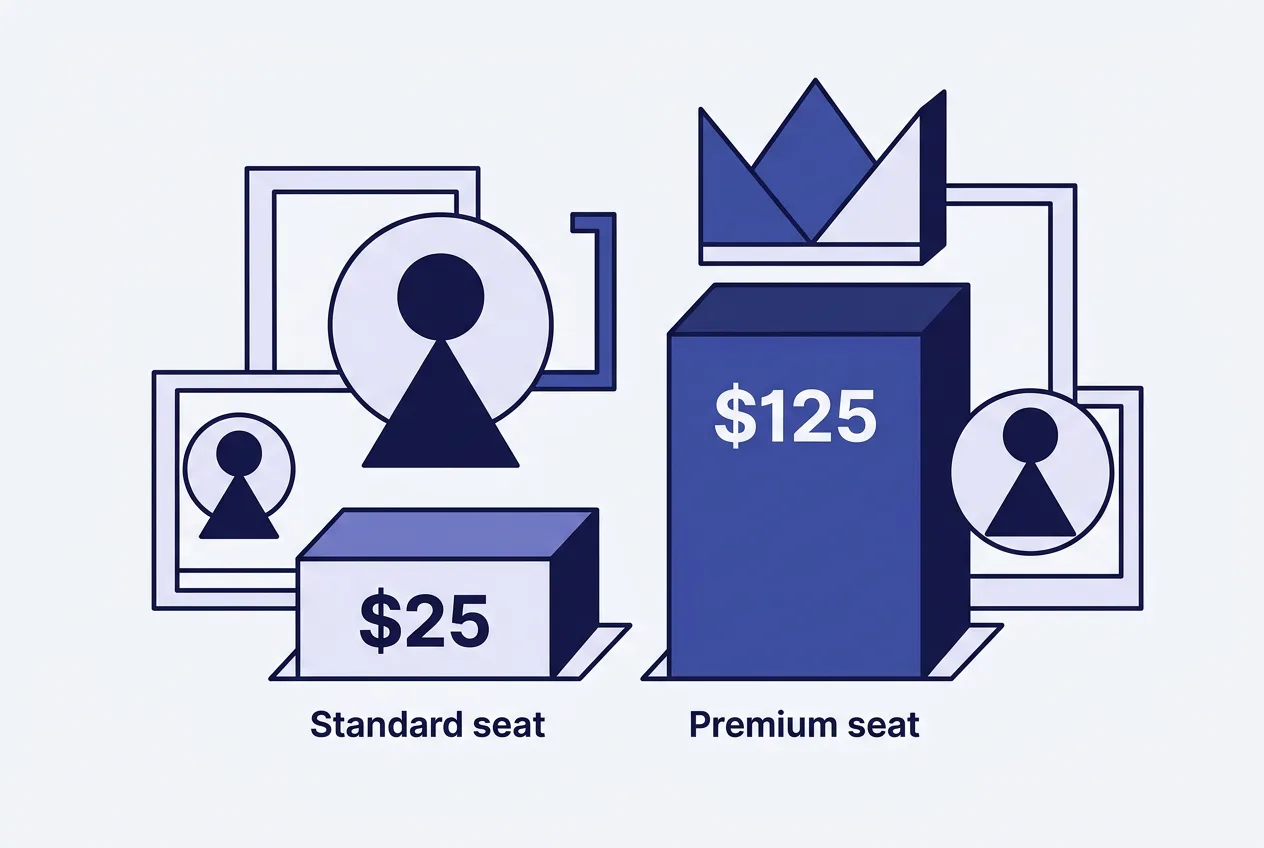
Every Team seat includes Claude Code. Pooled API credits equal $20 per standard seat or $100 per premium seat, capped at $500 per team. Seats can be mixed, and the plan adds SSO and admin controls.
Enterprise agreements begin at $20 per seat with annual billing and a 20-seat minimum. All usage is charged at standard API rates rather than included credits. Additional controls include SCIM, audit logs, custom data retention and role-based permissions.
| Plan | Monthly Price | Usage Multiplier | API Credits |
|---|---|---|---|
| Pro | $20 | 1x | None |
| Max | $100 | 5x | $100 |
| Ultra | $200 | 10x | $200 |
| Team Standard | $25/seat | 1.25x | $20/seat |
| Team Premium | $125/seat | 6.25x | $100/seat |
Anthropic Claude API Limits 2026 and Token Costs
API access operates separately through the Claude Console on a pay-per-token basis. Current rates per million tokens are $0.10 input and $0.50 output for Haiku 5.5 up to 100K tokens, $2 and $10 for Sonnet 5.5, $4 and $20 for Opus 5.5, and $10 and $50 for Fable 5.1.
Prompt caching can reduce input costs to 5–10 percent of the base rate. Batch API processing offers roughly 50 percent discounts. Organizations set monthly spend caps and face rate limits that depend on their account tier.
Max, Ultra and Team plans allocate separate monthly API credits for non-interactive Platform and SDK calls. These credits do not apply to live Claude Code sessions. Workload testing with actual context sizes and model choices remains the most reliable way to estimate monthly spend.
Frequently asked questions
Does Claude Code require a separate subscription?
No. Claude Code is included in every paid Claude plan and shares the same usage pool as chat features. It is not available on the free tier.
What happens when Team API credits are exhausted?
Additional usage is billed at standard API rates up to the team spend cap. Credits are pooled monthly and reset at the start of each billing cycle.
Are annual discounts available on Team plans?
Yes. Standard seats drop to $20 per month and Premium seats to $100 per month when paid annually. Enterprise requires annual billing by default.
How do rolling five-hour limits affect Claude Code sessions?
Usage is measured across all Claude activity, not just code tasks. Heavy agentic workflows can exhaust the window faster than simple chat, after which new requests are blocked until the window resets.
Comments 9