
Inception Mercury 3 Review: Capabilities, API Pricing, Context Limits and Agent Benchmarks
Inception Mercury 3 delivers 1M token context and over 1,000 tokens per second through its diffusion architecture. The model targets agentic workflows with OpenAI-compatible APIs.

Inception Mercury 3 became available on October 19, 2026, as a diffusion-based LLM from Inception Labs. It processes tokens in parallel rather than sequentially, reaching speeds above 1,000 tokens per second while supporting a 1 million token context window.
Inception Mercury 3 Review: Architecture and Core Capabilities
The model scales beyond 40 times the parameter count of the original Mercury release without losing throughput. It handles tool calling, structured JSON outputs, and adjustable reasoning effort levels. These features suit agent loops that require repeated tool use and structured data exchange.
Developers access the model through an OpenAI-compatible endpoint on the Inception API, OpenRouter, Baseten, and Vercel. Real-time applications such as voice agents, browser navigation, and coding sub-agents benefit from median generation times near 0.9 seconds. The architecture supports up to 131,000 output tokens per request.
Early deployments appear in tutoring systems, customer support agents, and internal search tools. Users report stable performance on long-context tasks that previously required chunking with smaller windows. Independent verification of third-party benchmarks remains limited at launch.
Mercury 3 API Pricing, Context Limits, and Speed Benchmarks
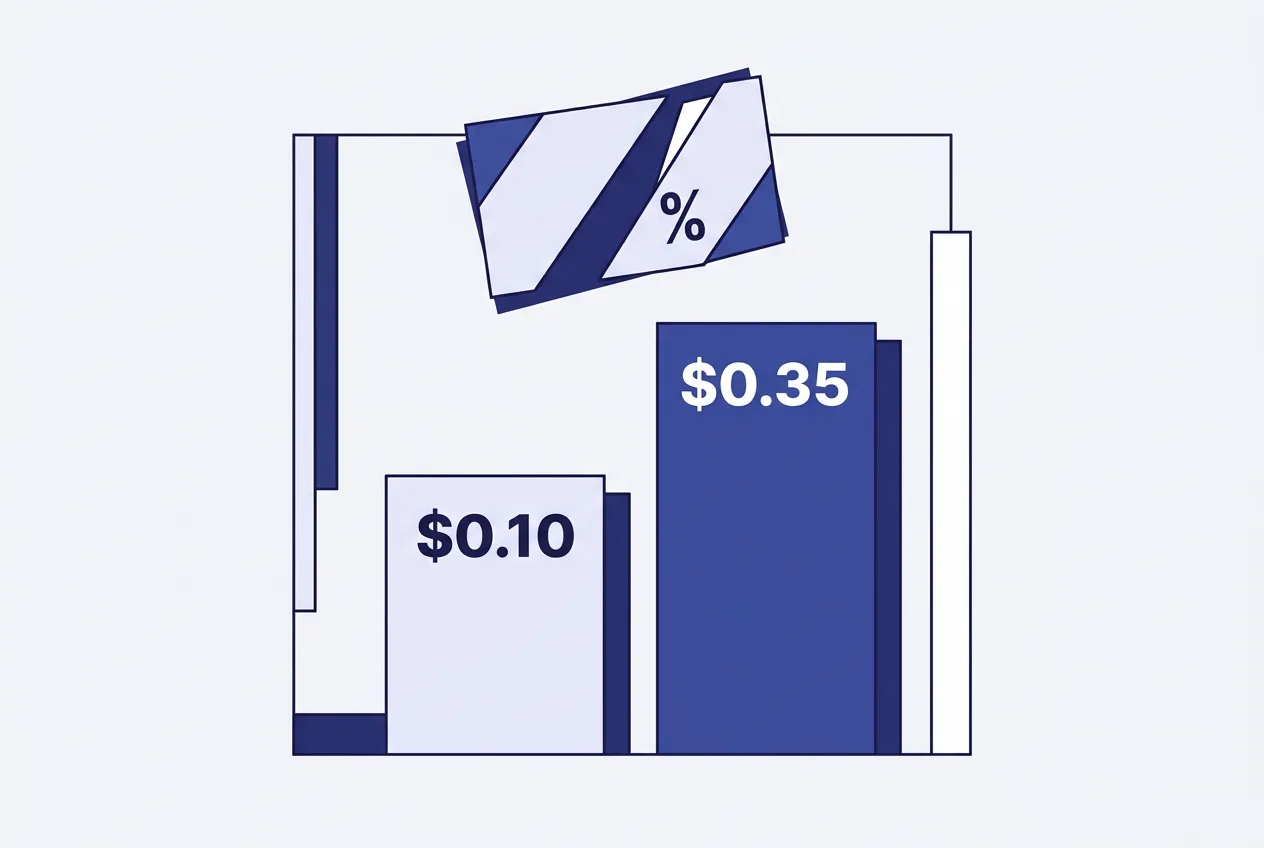
Launch pricing stands at $0.10 per million input tokens and $0.35 per million output tokens, half the regular rate of $0.20 and $0.70. Cached inputs receive a 90 percent discount to roughly $0.01 per million. These rates apply across the listed providers during the initial period.
The 1 million token context exceeds the 260,000 tokens available in Mercury 2.5. Maximum output reaches 131,000 tokens. On NVIDIA hardware the model sustains 1,068 tokens per second, four to eight times faster than GPT-6 Luna or Claude Haiku 5.5 under comparable loads.
| Model | Input price per 1M | Output price per 1M | Context window | Tokens per second |
|---|---|---|---|---|
| Inception Mercury 3 (launch) | $0.10 | $0.35 | 1M | 1,068 |
| GPT-6 Luna | $0.15 | $0.60 | 1M | 150-250 |
| Claude Haiku 5.5 | $0.12 | $0.55 | 200K | 200-300 |
Reported benchmark results show parity or gains on IFBench, GPQA Diamond, and SWE-Bench Atlas. On 50 Mind2Web web-agent tasks the model reached 50 percent success at token costs similar to GPT-6.1-Sol. Latency advantages appear most clearly in multi-step agent cycles where each iteration must complete under one second.
Agent Use Cases and Practical Limitations
Teams building browser agents or multi-tool workflows gain from the parallel token refinement and tunable reasoning settings. Education platforms use the model for step-by-step tutoring with long conversation histories. Support agents handle structured ticket data and external API calls within the same session.
Current constraints include the absence of dedicated enterprise capacity and compliance certifications at launch. Broader availability and additional variants are expected in coming months. Users should test specific agent scenarios directly, as third-party evaluations continue to emerge.
Frequently asked questions
What is the launch price for Inception Mercury 3 API calls?
Launch rates are $0.10 per million input tokens and $0.35 per million output tokens, with cached inputs at $0.01 per million. These rates apply through Inception API, OpenRouter, Baseten, and Vercel.
How large is the context window in Mercury 3?
The model supports a 1 million token context window and up to 131,000 output tokens. This exceeds the 260,000 token limit of Mercury 2.5.
How fast does Mercury 3 generate tokens compared with other models?
It sustains 1,068 tokens per second on NVIDIA GPUs, four to eight times faster than GPT-6 Luna or Claude Haiku 5.5 in tested conditions. Median generation time reaches 0.9 seconds.
Which agent benchmarks does Mercury 3 lead or match?
It matches or exceeds GPT-6 Luna and Claude Haiku 5.5 on IFBench, GPQA Diamond, and SWE-Bench Atlas. It achieved 50 percent success on 50 Mind2Web navigation tasks.
Comments 10