
NVIDIA Nemotron 3.5 review: Bolt and Super VL open weights, hardware, benchmarks
NVIDIA released Nemotron 3.5 Super VL and Bolt on October 15, 2026. This review examines their open weights, hardware demands, benchmarks, and agent deployment scenarios.
NVIDIA released two new open-weight models on October 15, 2026: Nemotron 3.5 Super VL and Nemotron 3.5 Bolt. Super VL targets enterprise multimodal agents, while Bolt focuses on local deployment on consumer GPUs. Both models carry the OpenMDW-1.1 license that permits commercial use with attribution.
Super VL uses a 120B total parameter MoE architecture with 12B active parameters and supports up to 1M token context plus text, image, document, and video inputs. Bolt 74B-A9B runs in a 24 GB footprint after quantization and targets RTX and DGX Spark systems for coding, research, and tool-calling tasks.
NVIDIA Nemotron 3.5 review: hardware requirements and deployment
Super VL runs on data-center GPUs such as one GB200 or H200, two H100 cards, or a DGX Spark system when using NVFP4 precision. The model supports the C-RADIO vision encoder and reaches median speeds of 436 tokens per second on Artificial Analysis benchmarks under optimized conditions.
Bolt 74B-A9B ships as an IQ2_XXS GGUF file of roughly 22 GB. Practical setups require a 32 GB or larger GPU or an RTX Spark with 64–128 GB unified memory when vision and long context are active. Supported runtimes include llama.cpp, Ollama, LM Studio, Unsloth, and vLLM. A smaller Bolt E4B variant for embedded voice agents arrives October 23, 2026.
Weights, datasets, and post-training recipes sit on Hugging Face. Users can fine-tune both models with NeMo on domain-specific data to raise accuracy in specialized workflows.
Benchmarks and comparison with similar open models
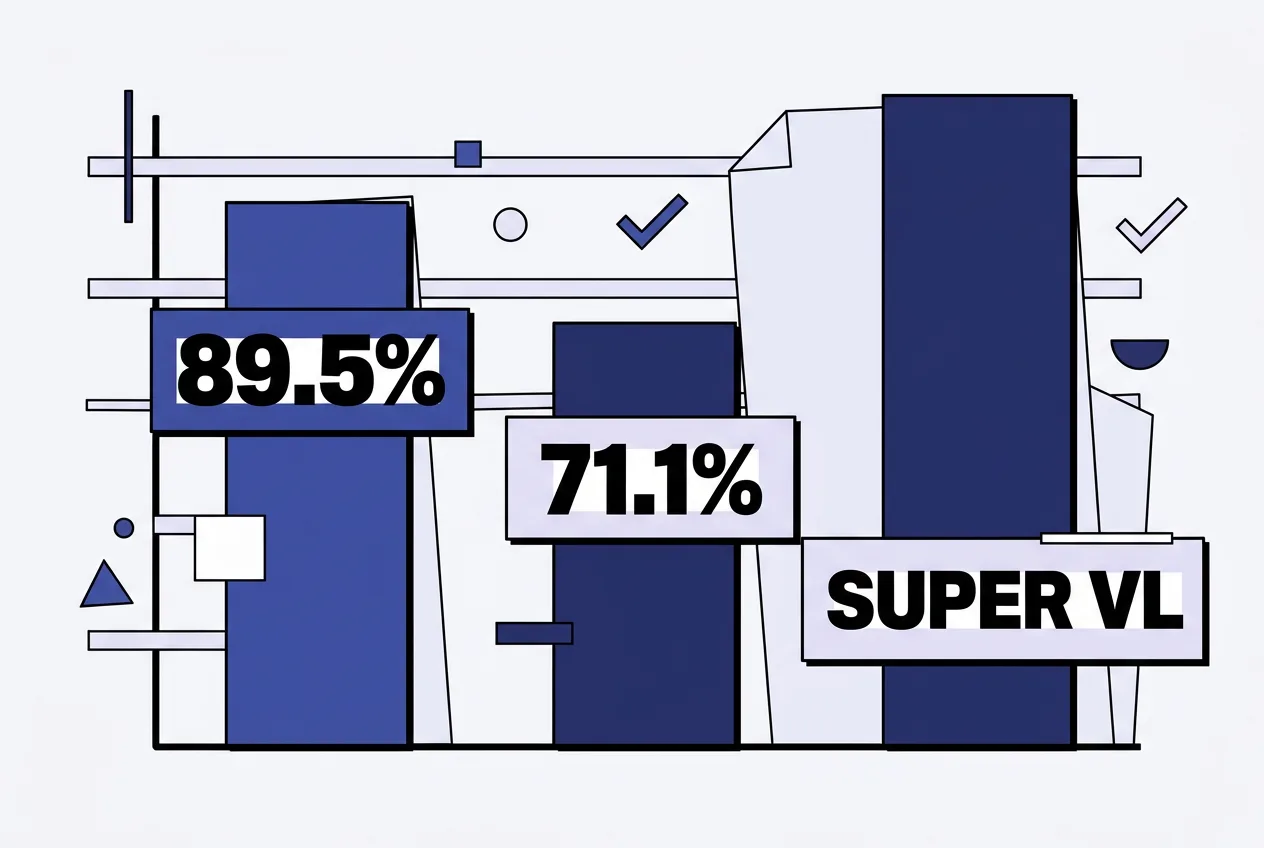
Super VL in NVFP4 or BF16 reaches 89.5–89.9 % on GPQA Diamond, 71.1 % on SWE-bench Verified, and 77.5–78 % on BrowseComp. Its Artificial Analysis Intelligence Index score of 26–26.5 leads among current US open-weight models. It also records 63.44 % on Hermes Bench, outperforming its larger Nemotron 3 Ultra predecessor on several agent tasks.
Bolt 74B-A9B scores 86.43 % on GPQA Diamond, 50.98 % on Terminal-Bench 2.1, and 66.75 % on BrowseComp. It tops the open-model class on PinchBench at 87.82 % and holds an Artificial Analysis Index near 21. On RTX Spark it sustains about 84 tokens per second with the LiLiCorr drafter.
| Metric | Super VL (NVFP4) | Bolt 74B-A9B (IQ2_XXS) | Qwen3.6 35B-A3B |
|---|---|---|---|
| GPQA Diamond | 89.5–89.9 % | 86.43 % | 82.1 % |
| Terminal-Bench 2.1 | 60.8–66.7 % | 50.98 % | 47.3 % |
| BrowseComp | 77.5–78 % | 66.75 % | 61.4 % |
| Memory footprint | 2× H100 | 24 GB | ~28 GB |
Both models trail closed frontier systems on raw scale but deliver competitive agent performance at lower cost and with full weight access.
Use cases, limitations, and next steps
Super VL suits always-on enterprise agents that process documents, video, and tool calls in data centers. Bolt targets local coding assistants, web research agents, and embedded voice interfaces on RTX hardware. Partners report accuracy jumps from 28 % to 72 % after domain-specific post-training on medical claims data.
Limitations include the need for NVIDIA hardware for peak efficiency and still-limited independent third-party agent harness results as of October 19, 2026. Context windows drop from 1M tokens on Super VL to 256K on Bolt after quantization.
Users should test both models on their target workloads before production rollout. Ongoing community optimizations and the upcoming Bolt E4B release will expand deployment options further.
Frequently asked questions
What license covers Nemotron 3.5 Super VL and Bolt?
Both models use the OpenMDW-1.1 license, which allows commercial use provided attribution and license notice requirements are met.
How much GPU memory does Bolt 74B-A9B need?
The official GGUF file occupies about 22 GB. Practical runs with vision and longer context recommend 32 GB or more on RTX cards or 64–128 GB unified memory on RTX Spark.
Which tasks show the largest gains after domain fine-tuning?
Partners report accuracy rising from 28 % to 72 % on medical claims processing after NeMo post-training on proprietary data.
When will the smaller Bolt E4B variant ship?
NVIDIA schedules the 4 GB Bolt E4B release for October 23, 2026, aimed at embedded voice and conversational agents on Jetson and RTX hardware.
Comments 12