
Mistral Voxtral 3 Voice Agent SDK Review: 50+ Languages, Tool Use Limits and EU Hosting Pricing
Mistral Voxtral 3 provides an integrated voice agent SDK with multilingual STT and TTS, EU-hosted API access, and native tool calling for production conversational systems.
Mistral Voxtral 3 supplies a complete voice agent SDK that combines speech-to-text, text-to-speech, and tool-calling pipelines in a single streaming workflow. Launched on 20 October 2026, the family includes models for transcription, synthesis, and agent orchestration built on LiveKit. Developers gain configurable latency between 80 and 1,200 milliseconds along with SIP and WebRTC endpoints for telephony and browser use.
The SDK routes audio input through STT, passes results to a reasoning model such as Mistral Small for tool execution, then returns output via TTS without intermediate buffering. This architecture suits contact-center automation, internal assistants, and workflow bots that must interact with business systems in real time.
Mistral Voxtral 3 Language Coverage and Core Features
STT models handle more than 50 languages, including all 24 official EU languages and several low-resource Asian and Indic tongues. Real-time transcription works in 35 languages, while TTS supports 35 languages and over 50 dialects. Context biasing and speaker diarization come built into the Small and Mini Transcribe variants, along with end-of-turn detection that reduces false interruptions.
Pro Voice cloning accepts up to 30 minutes of reference audio for high-fidelity speaker recreation. The TTS engine accepts emotion and pace tags, allowing preset voices or cloned ones to match brand tone. Tool use occurs natively inside the agent loop, letting the model retrieve data or trigger external APIs without separate orchestration layers.
Practical tests show the pipeline maintains coherence across multi-turn exchanges when the reasoning model receives clear function schemas. Latency settings let teams trade accuracy for speed: 80 ms suits simple queries, while 400–600 ms improves tool accuracy on complex requests. Self-hosting options exist for teams that need full data control beyond the EU API endpoint.
Mistral Voxtral 3 Pricing, Tool Limits and Deployment Choices
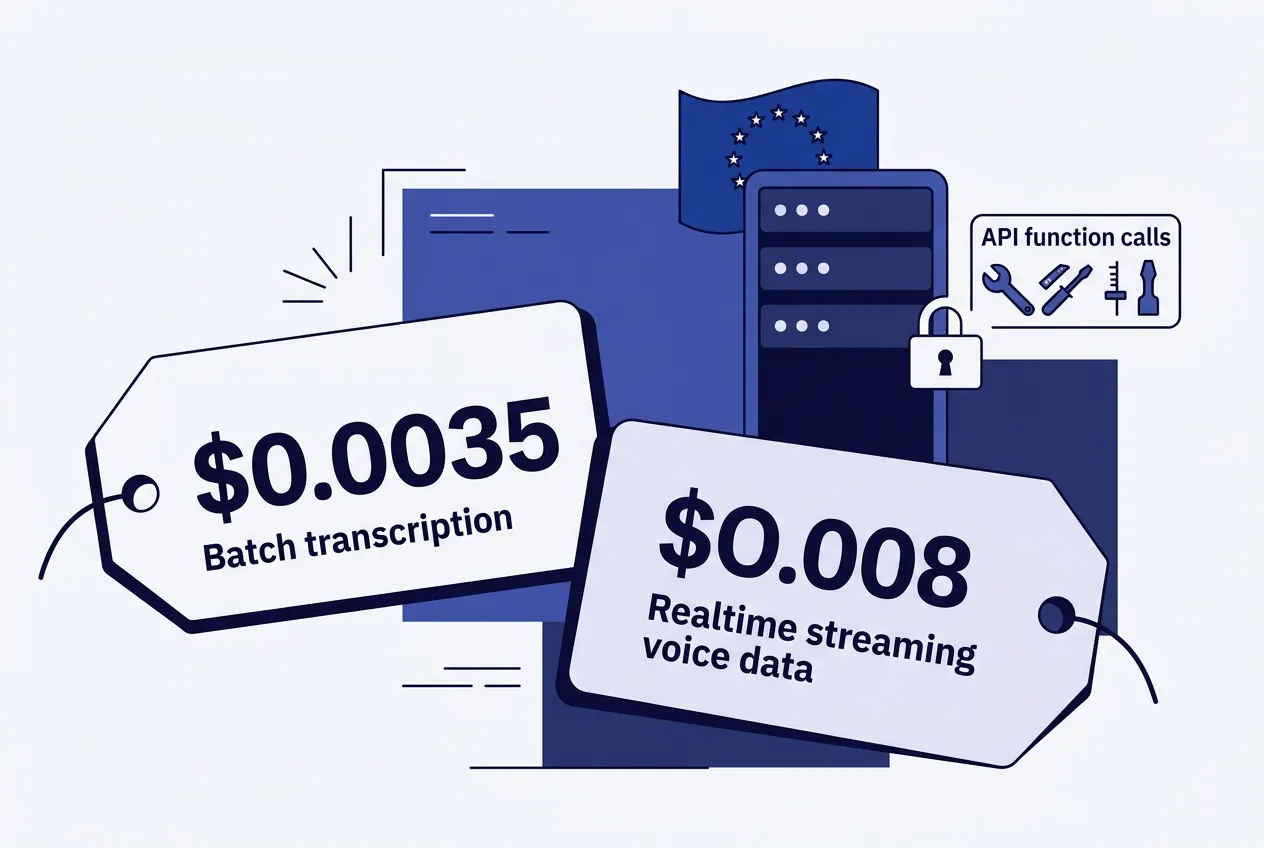
API pricing on the standard tier lists Voxtral Mini Transcribe 3 at $0.0035 per minute for batch jobs and $0.008 per minute for realtime streams. Voxtral Small Transcribe 3 costs $0.004 per minute. TTS runs at $13 per million characters. Batch and cached routes reduce these figures further, and Pro Voice cloning adds roughly $0.001 per minute in reported tests.
| Model | Mode | Price (USD) | Notes |
|---|---|---|---|
| Voxtral Mini Transcribe 3 | Batch | $0.0035/min | Lowest cost for offline processing |
| Voxtral Mini Transcribe 3 | Realtime | $0.008/min | Streaming with end-of-turn detection |
| Voxtral Small Transcribe 3 | Batch | $0.004/min | Higher accuracy tier |
| Voxtral TTS 3 | Standard | $13 per 1M chars | Emotion and pace control included |
Tool-use limits remain unspecified beyond the general rate limits of the underlying reasoning model. Agents inherit whatever caps apply to Mistral Small API calls, so developers must monitor token consumption when chaining multiple function calls inside a single voice turn. No separate per-turn quota for the voice SDK appears in the launch documentation.
Deployment runs through Mistral’s EU-hosted API for data-sovereignty requirements or via open-weight downloads for on-premise installation. The EU endpoint aligns with GDPR and related compliance needs without forcing data movement outside the region. Teams evaluating alternatives such as Deepgram or ElevenLabs note Mistral’s lower per-minute rates and integrated tool pipeline, though they must still benchmark latency and cloning quality against their specific voice traffic patterns.
Early adopters report success in multilingual contact-center pilots where the 50-language STT set removes the need for separate language routing. Self-hosted instances require GPU resources comparable to other 7–13 B parameter audio models, with documented support for standard inference stacks. Ongoing updates are expected to refine tool-calling accuracy and add more dialect options.
Frequently asked questions
How many languages does Mistral Voxtral 3 support for realtime transcription?
Realtime STT covers 35 languages while full batch transcription reaches over 50 languages including all 24 official EU languages.
What are the current API prices for Voxtral Mini Transcribe 3?
Batch processing costs $0.0035 per minute and realtime streams cost $0.008 per minute on the standard tier.
Does the Voxtral 3 SDK impose separate tool-calling limits?
Tool limits follow the general API rate limits of the connected reasoning model such as Mistral Small; no additional per-turn voice caps have been published.
Can Mistral Voxtral 3 run on customer infrastructure?
Open-weight components allow self-hosting alongside the EU-hosted API option for teams requiring full data control.
Comments 13